Artist Profile: Soprano Julia Bullock on Human Connection, Artistic Creation, and the Future of Opera
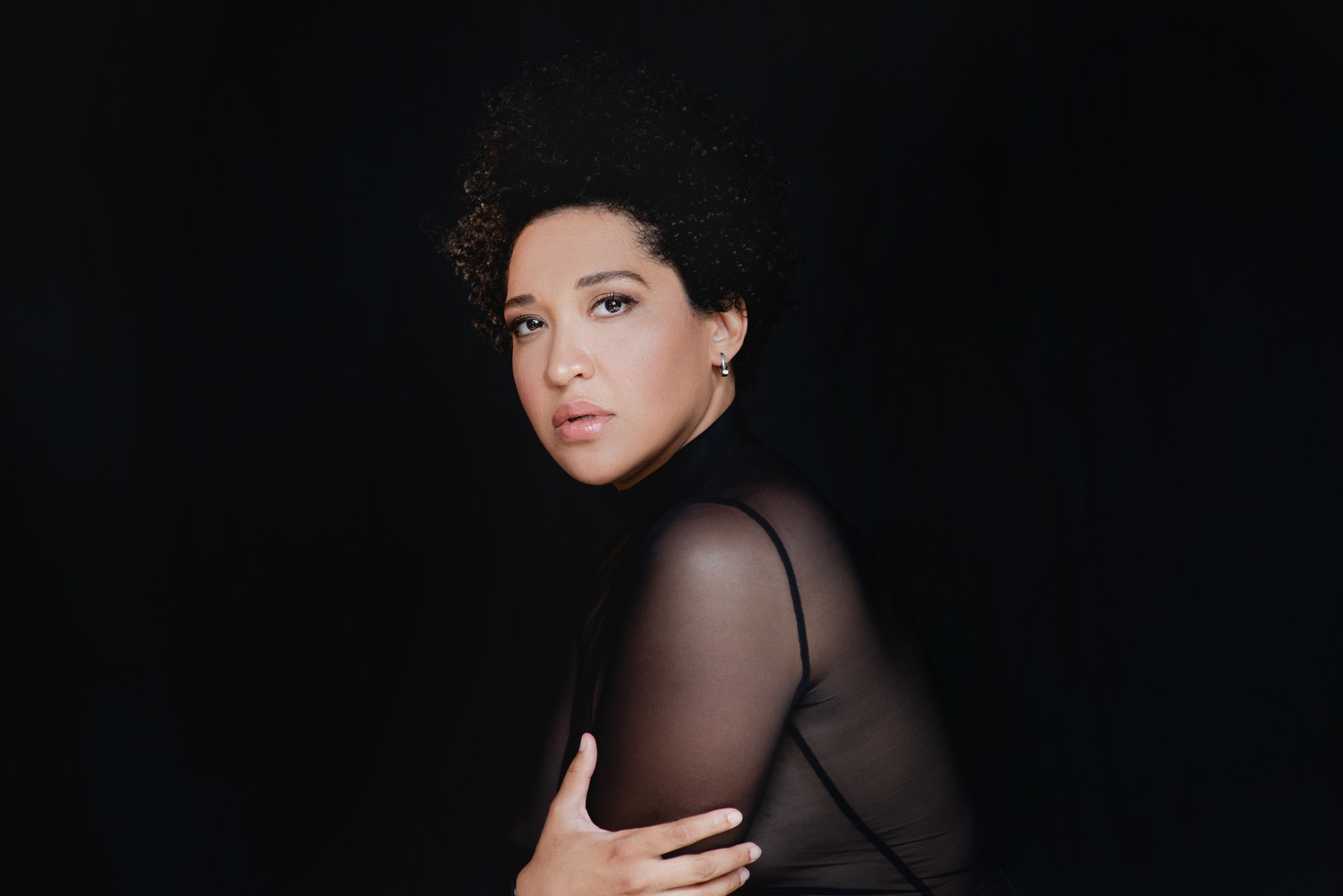
There is hardly an artist in the Western opera world with a career as eclectic as Julia Bullock’s. Her star-studded operatic and concert career has taken her across the globe with appearances at the Metropolitan Opera, Festival d’Aix-en-Provence, and the Bolshoi Theater, to name a few. Beyond her numerous performance credits, she has been artistic curator and artist-in-residence at institutions including London’s Philharmonia Orchestra, New York’s Metropolitan Museum of Art, London’s Guildhall School of Music and Drama, and the San Francisco Symphony.
Honored as a 2021 Artist of the Year and “agent of change” by Musical America, Bullock combines her artistry with social consciousness and activism. Through original projects such as “Perle Noire: Meditations for Joséphine” and El Nino: Nativity Reconsidered, Bullock has amplified the voices of communities traditionally underrepresented in the Western classical music canon.
Despite her busy schedule, Bullock maintains a crystalline conception of who she wants to be as an artist: engaged, sensitive, and profoundly human. In between masterclasses and performances at Rice University, she discussed her identity and practice as an artist, her views on the opera world and world writ large, and her upcoming appearance with the Boston Modern Orchestra Project.
Bullock’s start in the world of opera was through movement, musical theater, and dance. Opera didn’t cross her mind until her stepfather entered her life. His close friendship with an arts reviewer in Dallas, Texas, helped introduce Bullock to the art form. With access to burned CDs and DVDs of iconic operatic productions — such as Peter Sellars ’80’s productions of Mozart’s “Da Ponte” trilogy and Handel’s Theodora — Bullock discovered a new passion. From the moment she first heard the recordings of singers like Régine Crespin, Frederica von Stade and Shirley Verrett, it only took three months for Bullock to realize opera was what she wanted to pursue in life.
After her time as an Artist in Training with Opera Theater of Saint Louis, Bullock attended the Eastman School of Music, the Bard College Conservatory of Music, and the Juilliard School. While she followed a similar classical education path as many of her peers, Bullock’s prior artistic education and background in poetry, film, musical theater has made her artistic ethos more expansive than can be summed up by a conservatory education.
“It’s usually something rooted in ensuring that I am honoring every human being that I encounter, and also trying to share the fact that the extremes of the human experience are ones that we need to witness in one another,” Bullock said in an interview with The Crimson.
Especially in spaces like the prototypical Western classical concert hall, Bullock emphasises connection between individual people both in the creative process and performance. Refusing to view her audience as a monolithic entity to which a performance is simply given, she views every performance as an exchange of energy and respect she wants to “pay to every single person” with whom she shares the space. She views every rehearsal, every performance, every collaboration as a “time we are intentionally choosing to coexist”, and her belief in taking responsibility for the culture of every artistic space she inhabits could not be stronger.
In a field that fights to preserve its musical canon so fiercely and also open itself up to new and diverse voices, Bullock takes a teleological view of music’s purpose.
In her recent appearance with the Boston Modern Opera Project, Bullock performed two arias written specially for her by Matthew A. Aucoin ’12 with poetry by Paul Celan. Celan’s original poetry collection, titled “No-One’s Rose,” was written in 1963 in memory of Soviet poet-dissident Osip Mandelstam and carries themes of memory, loss, and genocide owing to Celan’s experiences as a Romanian Jew in World War II.
“As an American who identifies with my multi-ethnicities, it is profound to be given an opportunity to sing his words,” Bullock said.
In a time where people “commit such violence against one another,” she still holds fast to her ethos of intentional co-existence by performing and hearing such gripping poetry memorialized in music.
In addition to the Aucoin, Bullock also performed Samuel Barber’s “Knoxville: Summer of 1915,” a piece for voice and orchestra set to prose by the American writer James Agee. It is a quintessentially American piece with historical links to the city of Boston, having premiered in 1947 with soprano Eleanor Steber and the Boston Symphony Orchestra under the baton of Serge Koussevitzky. Renowned for its swells of emotion and lyrical vocal writing, the text of ‘Knoxville’ is from Agee’s 1957 novel “A Death in the Family,” written from Agee’s perspective as a child who lost his father while he was six to an automobile accident. Having lost her own biological father when she was nine, Bullock resonates deeply with the piece’s exploration of self-actualization, childlike wonder, and being defined by the people around oneself, especially during the tender years of childhood.
Bullock’s own choice to perform Knoxville and Aucoin at her recent concert is proof of the agency she enjoys as a well-established artist on the world stage. Striking a balance between canonical repertoire and works by her modern contemporaries, this position is not a mantle she bears lightly. It is but one of the many questions facing the world of opera today: how to remain artistically daring while honoring the traditions of old, fighting for the economic viability and cultural relevance of the art form, and how to make art in the midst of strife and political violence
“I think as long as you can find a place where you are gathering with people who you love and cherish, creating a culture that you feel is sustainable and will actually help you all really thrive and flourish together, that is enough,” Bullock said.
Beyond activism through her art, Bullock has advocated for more sustainable, ground-up art initiatives outside of and within opera companies — inspiring a deeper consideration of their cultural significance as institutions. While not yet a trend in the opera or classical music world, Bullock hopes that more institutions will start “honoring, representing, and researching” the cultural and political spaces they occupy, lest opera houses and symphony halls lose their meaning entirely. Yet, she acknowledges that formal spaces are not the only arbiters of meaning in music.
“Whether I was pursuing this career or not, I would still be singing and I would still be wanting to create meaningful connections with people through music-making every day. Even if it was something as direct as singing a song with my child, or making music with my husband in my home,” Bullock said.
Julia Bullock performed with the Boston Modern Orchestra Project on Nov. 6 in Jordan Hall, New England Conservatory.
—Staff writer Lara R. Tan can be reached at [email protected].
Want to keep up with breaking news? Subscribe to our email newsletter
Have a tip for The Crimson? Share it confidentially